Autistic, Not Broken: Why My Language Changed Everything
I'm autistic, not broken so I refuse to call it a disorder. Here's why that shift changed everything, and why you are not broken or defective. | Blessings Revolution
By Joshua S. Bentley
4/7/20264 min read
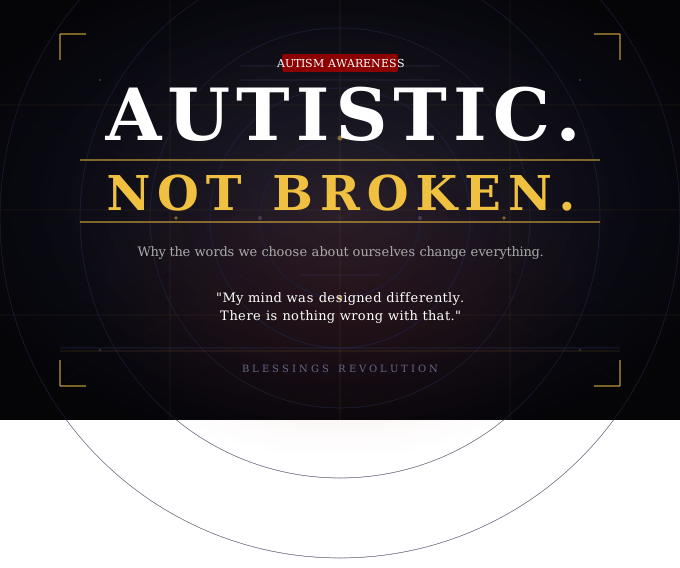
I'm Autistic — But I Don't Say I "Have Autism." Here's Why It Changes Everything.
By Joshua S. Bentley | Blessings Revolution | Autism Awareness Month
There is a difference between a label that limits you and a truth that sets you free. For me, the words I choose to describe myself are not a matter of semantics — they are a matter of identity, dignity, and power.
The Words We Use About Ourselves Matter More Than We Think
I am autistic. But I never say that I "have autism."
To some, that might sound like a minor distinction — a technicality, even. But to me, the difference between those two phrases has been one of the most transformational realizations of my life. And during Autism Awareness Month, I believe it is a conversation worth having openly, honestly, and without apology.
So let me explain.
What Does It Mean to Say Someone "Has Autism"?
When we say a person "has autism," we are saying that they have Autism Spectrum Disorder. That single word, disorder, carries enormous weight. It is not a neutral word. It carries an implicit message: that something is wrong. That something is broken. That something needs to be fixed.
The foundational idea behind classifying autism as a disorder is rooted in a broader cultural assumption — that anyone who thinks, processes, or experiences the world in a way that falls significantly outside of what is considered "typical" is, by definition, defective. Less than. Disordered.
I respectfully, but firmly, disagree.
Neurodiversity: A Different Way of Being
I believe in the concept of neurodiversity — the understanding that neurological differences like autism are not errors in the human experience, but natural and valuable variations of it. Just as biodiversity strengthens an ecosystem, neurodiversity enriches our world.
Through my Christian faith, I have come to hold this belief even more deeply. I do not believe that God makes mistakes. I do not believe I was created defectively. I believe I was created intentionally — wired differently, yes, but purposefully so.
When I frame my autism as a disorder, I am — consciously or not — agreeing with the idea that I am broken. That I am less valuable. That I am a problem to be solved rather than a person to be known. And that belief is not just inaccurate. It is profoundly damaging.
The Hidden Cost of Believing You're Broken
For years, I tried to be normal.
I tried to think like everyone else, respond like everyone else, process the world like everyone else. I masked. I mimicked. I performed a version of myself that I thought the world could accept — because I had internalized the message that who I actually was needed to be hidden, corrected, or apologized for.
What I discovered — slowly, painfully, and then all at once — was that I wasn't just trying to fit in. I was pretending. I was trying to pretend. And in doing so, I was burying the very things that make me uniquely, irreplaceably me.
The gifts I have to offer this world. The perspective only I can bring. The voice that was meant to be heard.
You cannot give your gifts to the world if you spend your life hiding them.
Why "I Am Autistic" Is an Act of Empowerment
Saying I am autistic — without the weight of "disorder," without the implication of defectiveness — is, for me, an act of radical self-acceptance.
It means: My mind works differently. And that is not a flaw.
It means: I think differently, process differently, experience the world differently — and there is nothing wrong with that.
It means: I was created for a unique purpose, and I am going to live into that purpose rather than spend my life running from it.
This is not denial. I am not pretending that being autistic comes without challenges. It does. Real ones. But there is a profound difference between acknowledging the challenges of being neurodivergent in a neurotypical world, and agreeing with the idea that your neurology is a mistake that needs to be corrected.
One is honest. The other is harmful.
This Is My Perspective — And Yours May Be Different
I want to be clear: this is my personal experience. My perspective. The framework that has brought healing, freedom, and empowerment to my life.
If you see things differently — if different language feels more true or useful to you or your loved one — I honor that completely. The autism spectrum is vast, and the diversity of experiences within it is profound. There is no single story. There is no one-size-fits-all.
What I am sharing is simply this: for me, choosing to see myself as different rather than disordered has been one of the most powerful decisions I have ever made.
A Word to Anyone Who Has Ever Felt Broken
If you have ever been made to feel like you needed to be fixed simply for being who you are — I see you. I have been there.
If you have ever hidden who you really are because the world made it clear that the real you wasn't welcome — I understand that ache more than I can say.
And I want you to hear this, clearly and without qualification:
You were not made broken. You were made on purpose. For a purpose.
The world does not need a more "normal" version of you. It needs the real you — fully expressed, fully alive, fully free.
Blessings Revolution and Autism Awareness Month
At Blessings Revolution, our mission is to bring light, love, and truth to every corner of the human experience — including the conversations that feel risky or complicated or countercultural.
Talking openly about autism as a Level 1 autistic individual is part of that mission. Not because my experience represents all autistic people — it doesn't, and I would never claim that it does. But because awareness grows when more voices are heard, not fewer. And the general public remains profoundly undereducated about the autism spectrum, its many levels, and the rich diversity of experience within it.
This Autism Awareness Month, I am choosing to speak. I am choosing to share. I am choosing to stand in my own story — not with arrogance, but with the quiet confidence of someone who has finally stopped apologizing for how he was made.
I am autistic.
I am not broken.
And neither are you.
Be blessed today — and go be a blessing!
— Joshua S. Bentley, Blessings Revolution